A marine robot may spend hours below the surface with no person watching each movement. The next step is shared autonomy: software handles routine motion while a human sets the task and takes control when conditions change.
For an operator planning inspection, survey, or repair work, that shift matters because underwater links are slow, limited, or unavailable. The robot has to keep working when the control room can't see every detail.
Quick read
- Autonomous underwater vehicles can follow planned routes without a live pilot.
- Remotely operated vehicles keep a direct human link for work that needs close control.
- The hard proof will be safe recovery when sensors lose sight of the seafloor.
Three kinds of marine robot
An autonomous underwater vehicle, or AUV, carries its own power and follows a route set before launch. It can collect sonar readings, images, or other sensor data, then return with the records after the mission.
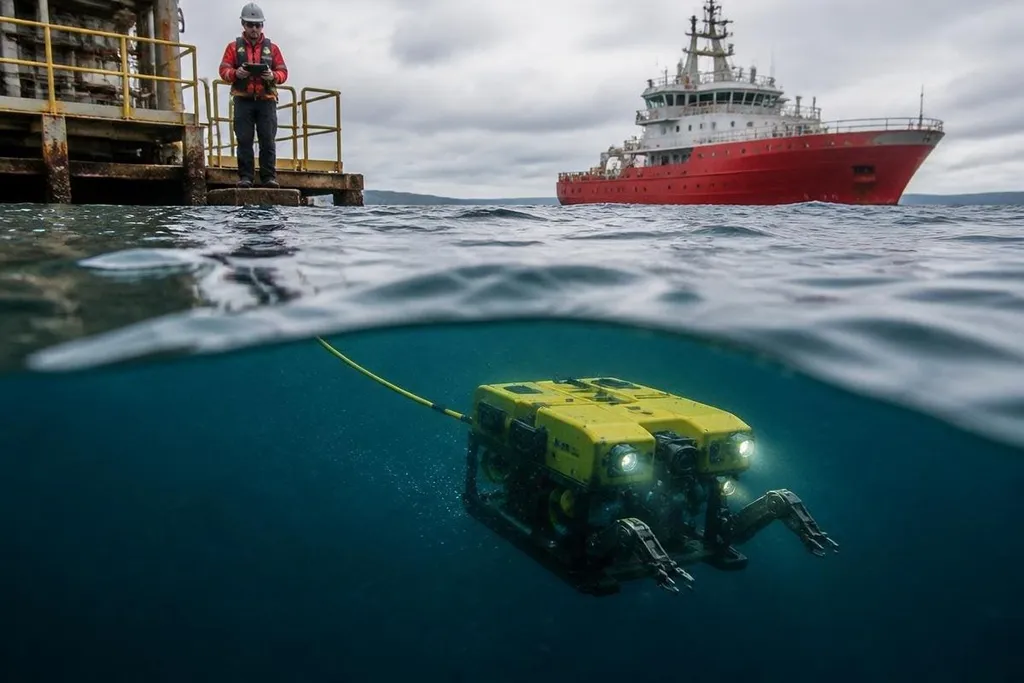
A remotely operated vehicle, or ROV, stays connected to a surface vessel through a tether. The tether carries power and data, while an operator controls the vehicle and its arm from above. That setup suits work where a person must watch each movement.
Surface vehicles travel on the water rather than below it. They can carry cameras and other sensors, and they can send data back to shore or to a nearby vessel while moving. Each type fits a different job, so describing all three as autonomous would hide the part that matters: who controls the motion and when.
The useful change is shared control
Full autonomy sounds neat until the robot meets poor visibility, moving sediment, a damaged structure, or an object missing from its map. A human may know what the mission needs, but software can handle steady speed, depth, and route checks without asking for every small command.
That division reduces the number of actions an operator must send.
The person can focus on the inspection plan and the data, while the robot keeps its heading or follows a survey line. If the system detects a condition outside its limits, it can pause, rise, hold position, or wait for a new command.
The quality of that handoff matters more than a smooth demo. A control system should show the operator where the robot is, what its sensors see, how much power remains, and why it stopped. Without that information, autonomy turns a clear task into a remote fault hunt.
A marine robot’s field result depends on the task, test site, weather, and date. Marine robotics reports from Robot24.com can put those details beside the result before the next section looks at where these machines can help.
Where marine robots can help
The work falls into a few clear groups. Survey robots map the seabed and inspect large areas. Inspection robots check structures, hulls, cables, and other equipment where sending people would add risk or cost. Sampling robots collect water, sediment, or biological material for later study.
Repair is harder. An arm must hold a tool against a target while water movement pushes the vehicle away. The robot also needs a stable view, enough power, and a way to recover if the tool slips. A machine that can reach a valve is useful; a machine that can reach it, turn it, and prove the result is much closer to a working system.
The data path matters too. A robot may collect more information than a crew can review during one mission. Good software should mark locations, attach images to the route, and show which areas need a second look. That saves a later search through unnamed files.
What remains unproven
Marine robots still face basic limits. Salt water damages hardware, pressure rises with depth, and radio signals don't travel well underwater. Acoustic links can carry commands over distance, but they offer less data and more delay than a normal wireless link.
Power sets another limit. An underwater robot that spends energy fighting current has less time for sensing or work. Recovery is part of the mission plan, too. A vehicle that completes its route but can't return safely has not completed the job.
The open question is how much autonomy operators will accept during work near valuable equipment. A system can act on its own during a survey, yet need permission before it touches a structure. That boundary will differ by task and by the cost of a mistake.
A buying and trial checklist
Before choosing a marine robot, check these points:
- Name the task: decide if you need mapping, inspection, sampling, or repair.
- Set the control mode: state which actions may run without approval.
- Check the link: confirm how commands and sensor data move underwater.
- Plan recovery: define what happens after a fault, lost signal, or low battery.
- Review the data: require clear location tags, time records, and mission logs.
- Test the handoff: make the operator take control during a planned fault.
A marine robot earns its place when it finishes a useful task, records what happened, and gives control back cleanly when the sea stops matching its map. I'd choose that measured system over a robot that performs a longer demo but leaves its failure rules unclear. The next proof will come from repeat missions where the robot returns with both the data and a clear account of every decision.